
Write down how the network forwards, not just what is plugged in.
Static routes, BGP, OSPF, IS-IS, EIGRP and the EVPN/VXLAN overlay, with the prefix lists, communities, policies and keychains they all share. Modelled per device and per virtual machine, and rendered into the config template you already write.
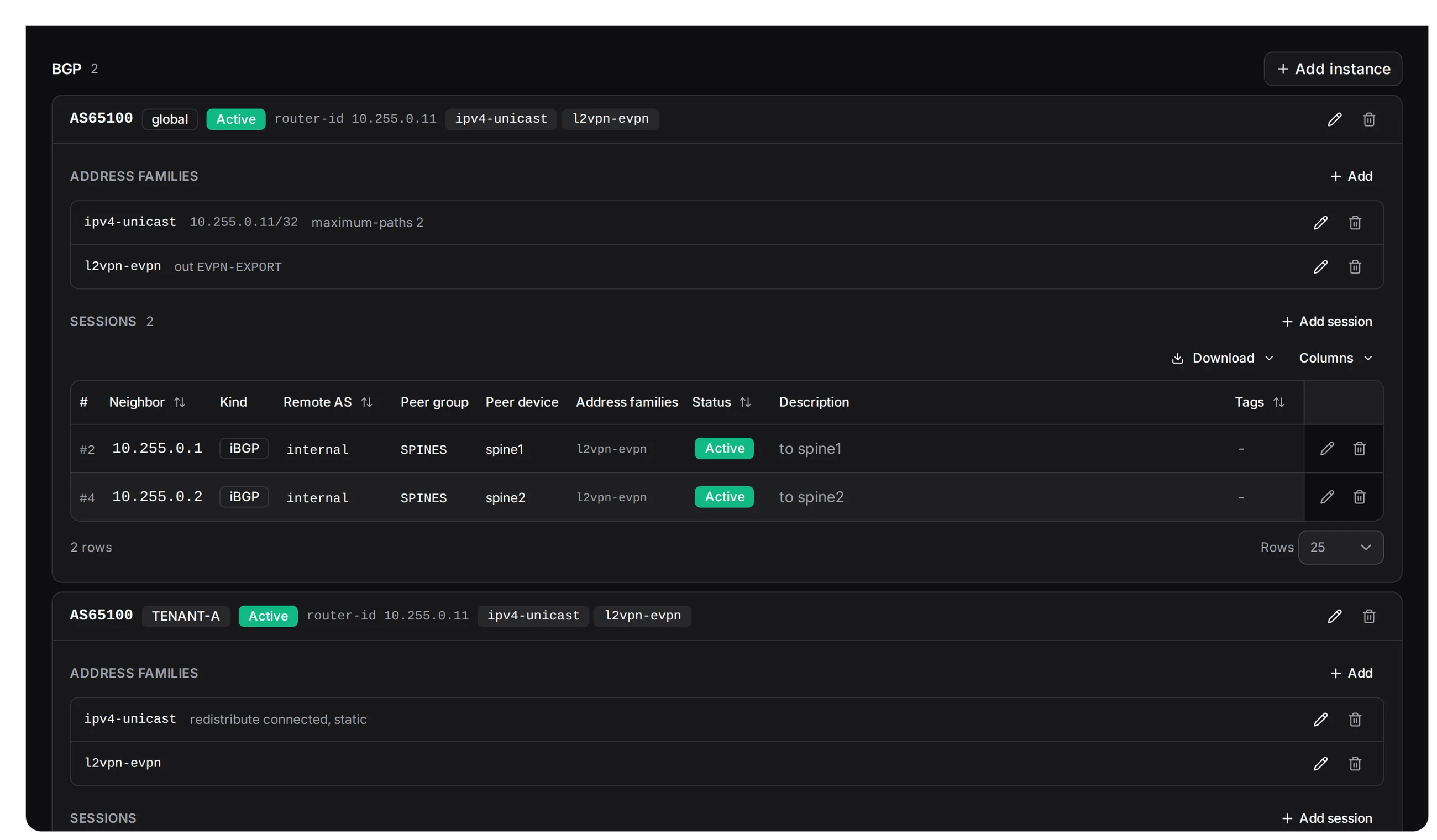
Catalogs are tenant-wide, instances belong to a box
Two ideas run through the whole module. A prefix list, a community list, an AS-path list, a routing policy, a keychain or a BFD profile is named once and used on every router that needs it. A static route, a BGP session or an OSPF interface belongs to one device or one virtual machine, and is scoped to that box's site exactly as the box is.
That split is what keeps a fabric describable. The SPINES peer group is written once and applies on every leaf; the session that uses it is a fact about one leaf.
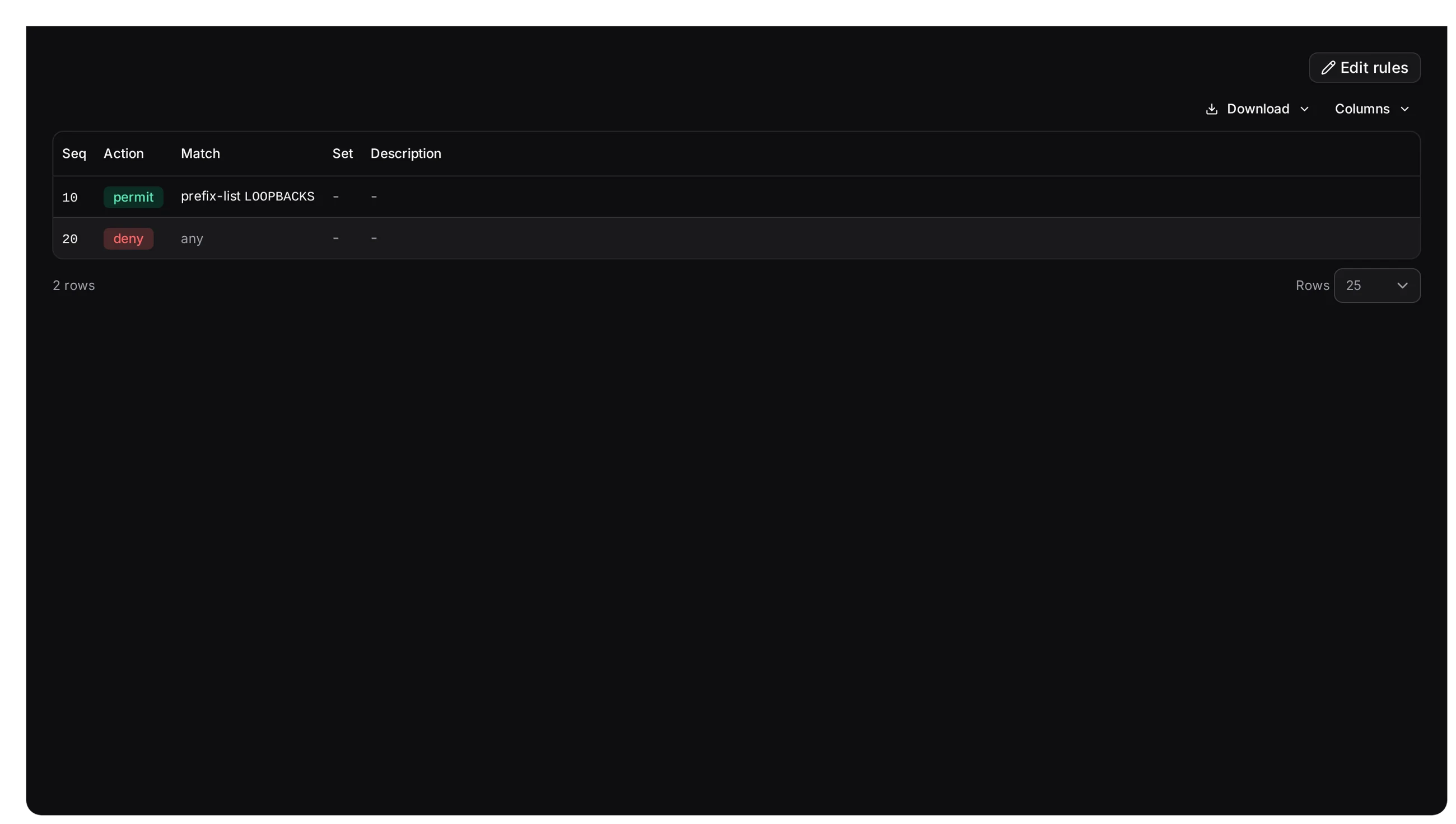
BGP, in three objects
An instance is router bgp on a device, one per table: its AS, its VRF (blank for the global table), router ID, cluster ID, graceful restart and whether BFD is the default for its neighbours. Each instance carries its address families, from ipv4-unicast through l2vpn-evpn, each with the networks it originates, its maximum paths, an import and an export policy, and what it redistributes.
A peer group is the neighbour settings named once: remote AS as a number or as *external* / *internal* for unnumbered fabrics, policies, BFD, multihop TTL, next-hop self, route-reflector client, timers and the keychain. A session names its far end by address or by interface, and inherits the group.
- Address families
- ipv4 and ipv6 unicast, vpnv4 and vpnv6, l2vpn-evpn, labeled unicast.
- Unnumbered
- A session can name an interface instead of an address, with external or internal in place of a remote AS.
- Route reflectors
- Cluster ID on the instance, route-reflector client on the group or the session.
- Authentication
- Keychains carry the keys, held in the secret store and revealed through an audited action.
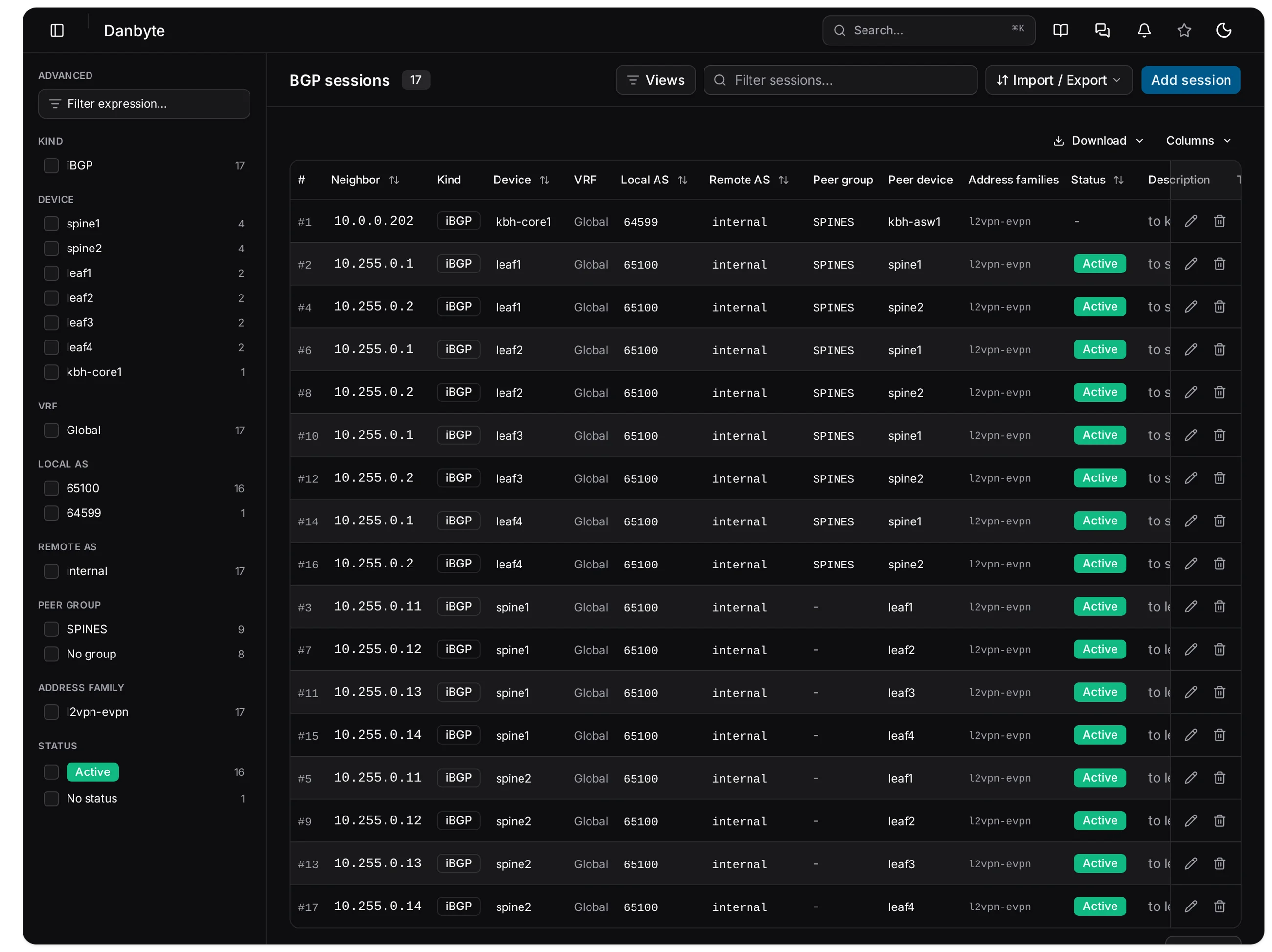
Sessions you can see from both ends
A session is one object with two ends, so it reads the same whichever device you open it from, and the topology map can draw it as a line between the two cards rather than a note on one of them.
OSPF, IS-IS and EIGRP
The interior protocols are modelled the same way: an instance on the device, its areas or levels, and the interfaces that run it with their cost, type, timers and authentication. An interface's Routing card shows what it participates in without leaving the interface.

The EVPN and VXLAN overlay
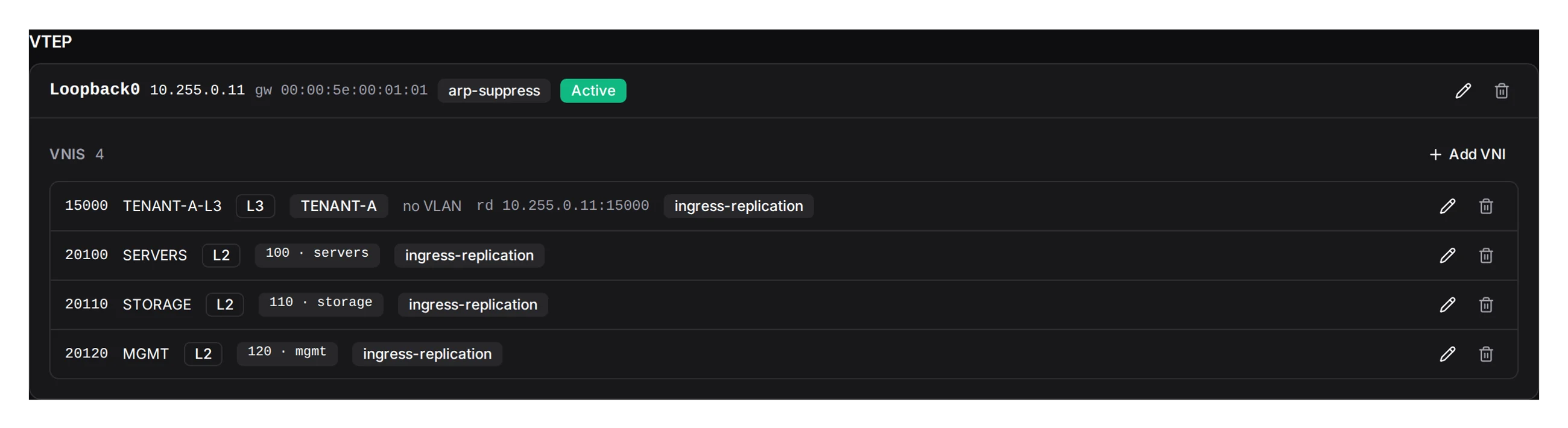
A leaf gets a VTEP with its source interface and the VNIs it carries, L2 VNIs bound to VLANs and an L3 VNI bound to a VRF, with anycast gateways where you want them. Ethernet segments cover multihoming, with their ESI and the interfaces in them.
Because the overlay is modelled rather than described, a fabric's leaves and spines can be rendered from the same template, and the map can draw the sessions that hold it together.
One template renders the whole box
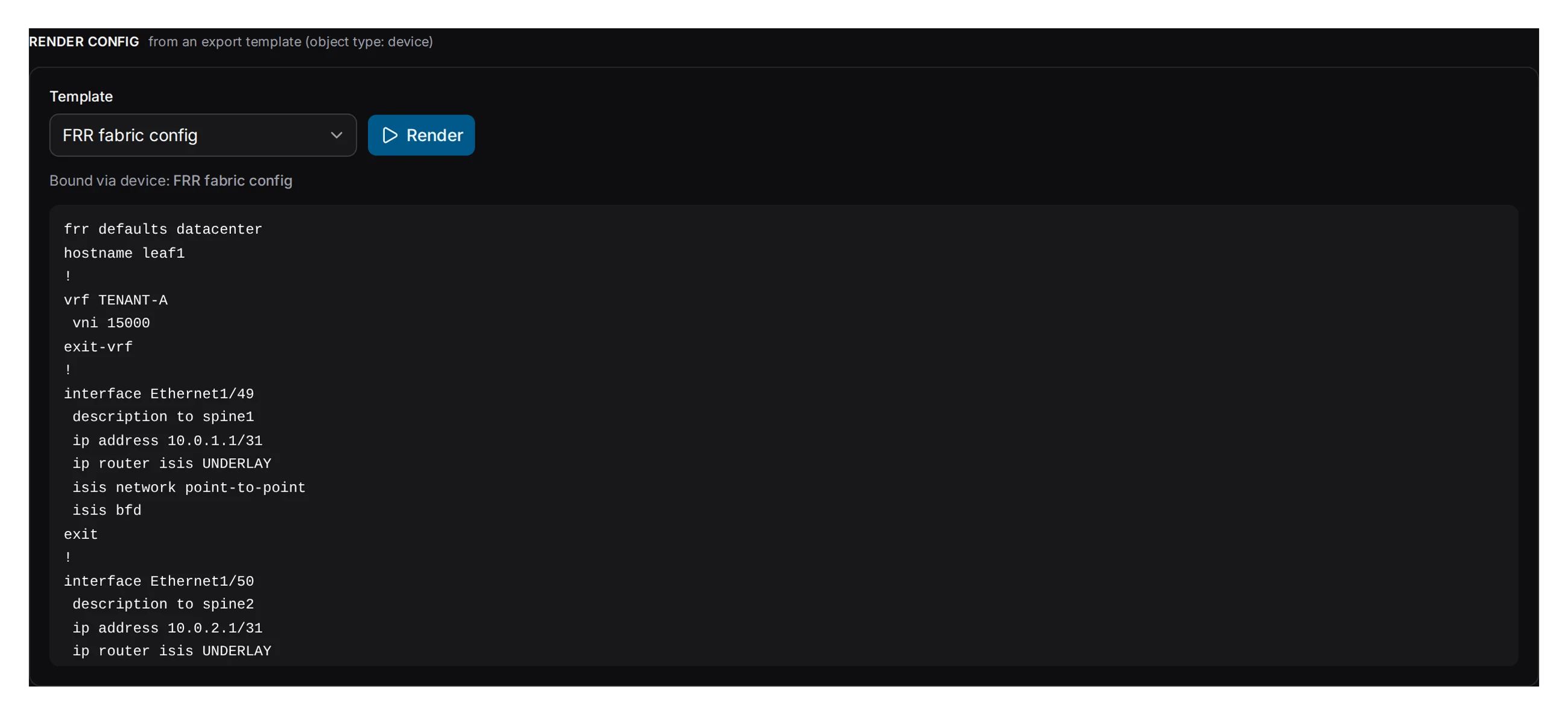
Everything modelled here reaches a device's config template as a routing block, so a single template renders the whole device in whatever vendor syntax you write. Danbyte renders what is modelled; the template stays yours.
Two complete worked templates, NX-OS style and FRR, ship in the docs, rendered against a leaf and spine fabric you can seed in one command.
Sessions on the map
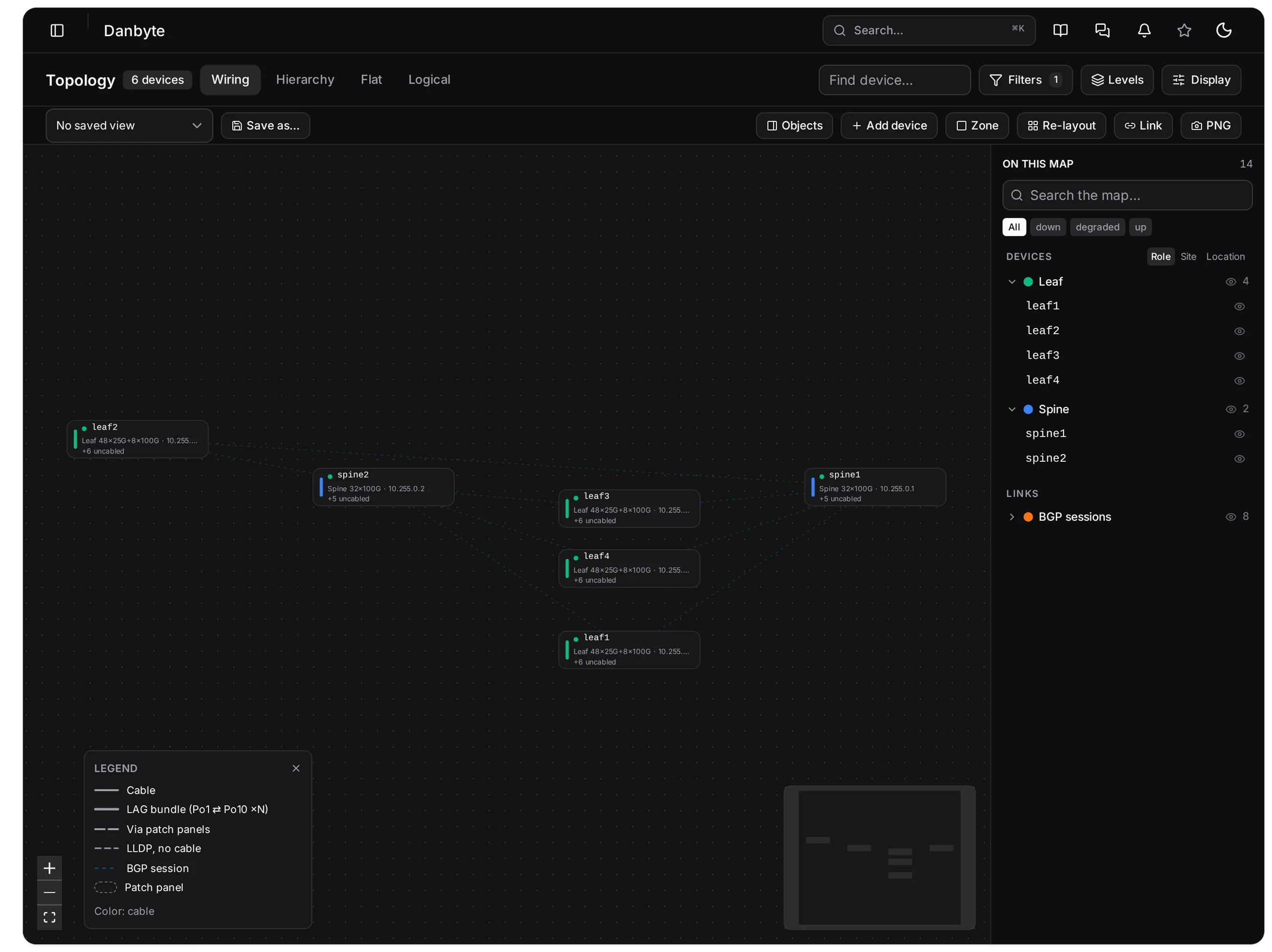
The topology Diagram draws BGP sessions as their own line family, which you can hide like any other. The layout still follows cables, so the sessions are drawn over the physical shape rather than rearranging it.
Virtual machines route too
A cloud router is a routing device that happens to be a VM, so virtual machines carry the same routing objects as hardware: instances, sessions, IGPs and static routes. A circuit can even terminate on a VM interface, which is how a CHR, pfSense, OPNsense or VyOS edge actually ends.
Questions
- Does Danbyte configure my routers?
- No. It models the intent and renders it through your own config template. Pushing the result is a job for your automation, and the config-drift runner can tell you where a box differs from the render.
- Which protocols are modelled?
- Static routes, BGP with peer groups and address families, OSPF, IS-IS, EIGRP, and the EVPN/VXLAN overlay with Ethernet segments, plus MPLS LDP and L3VPN. The shared policy objects are prefix lists, communities and community lists, AS-path lists, routing policies, keychains and BFD profiles.
- Do I have to model routing to use Danbyte?
- No. Routing is one module among many; an install that only documents addresses, hardware and cabling never has to open it.
In the documentation
See it with real data.
The live demo is a private instance with a populated estate, yours for thirty minutes. Or install it yourself in a few minutes.