
Single sign-on, and a permission model that survives an audit.
Bring your identity provider over SAML or OpenID Connect, map its groups to Danbyte's, and let people in without a second password. What they can see afterwards is decided by grants, scoped to a tenant and optionally to their own sites.
SAML 2.0 and OpenID Connect
An identity provider is configured deployment-wide or scoped to one tenant. On login Danbyte matches the user, creates them when JIT provisioning is on, and re-syncs their group membership from the groups the IdP asserted.
Only mapped groups grant anything: an unmapped group from your directory is ignored rather than guessed at. Local sign-in can be hidden entirely once SSO is in place.
- SAML 2.0
- Metadata URL or pasted XML, signed assertions, with the usual attribute mapping.
- OpenID Connect
- Any compliant provider: Entra ID, Okta, Keycloak, Authentik and friends.
- LDAP and AD
- Bind, search and group lookup, with the same group-to-group mapping.
- MFA
- Authenticator enrolment, lockout, and an admin path to clear it for somebody who lost their device.
Grants, not a fixed set of roles
A grant says: these object types, these actions, optionally narrowed by a filter. Groups hold grants and people hold groups. There is no hard-coded hierarchy to fight, and the built-in Administrator, Operator and Read-only groups are just grants you can read and change.
Permissions that matter on their own have their own grant: viewing support-contract cost, viewing SLA credits, reading a device's configuration. None of them is implied by being an administrator.
Nobody has to remember to write it down
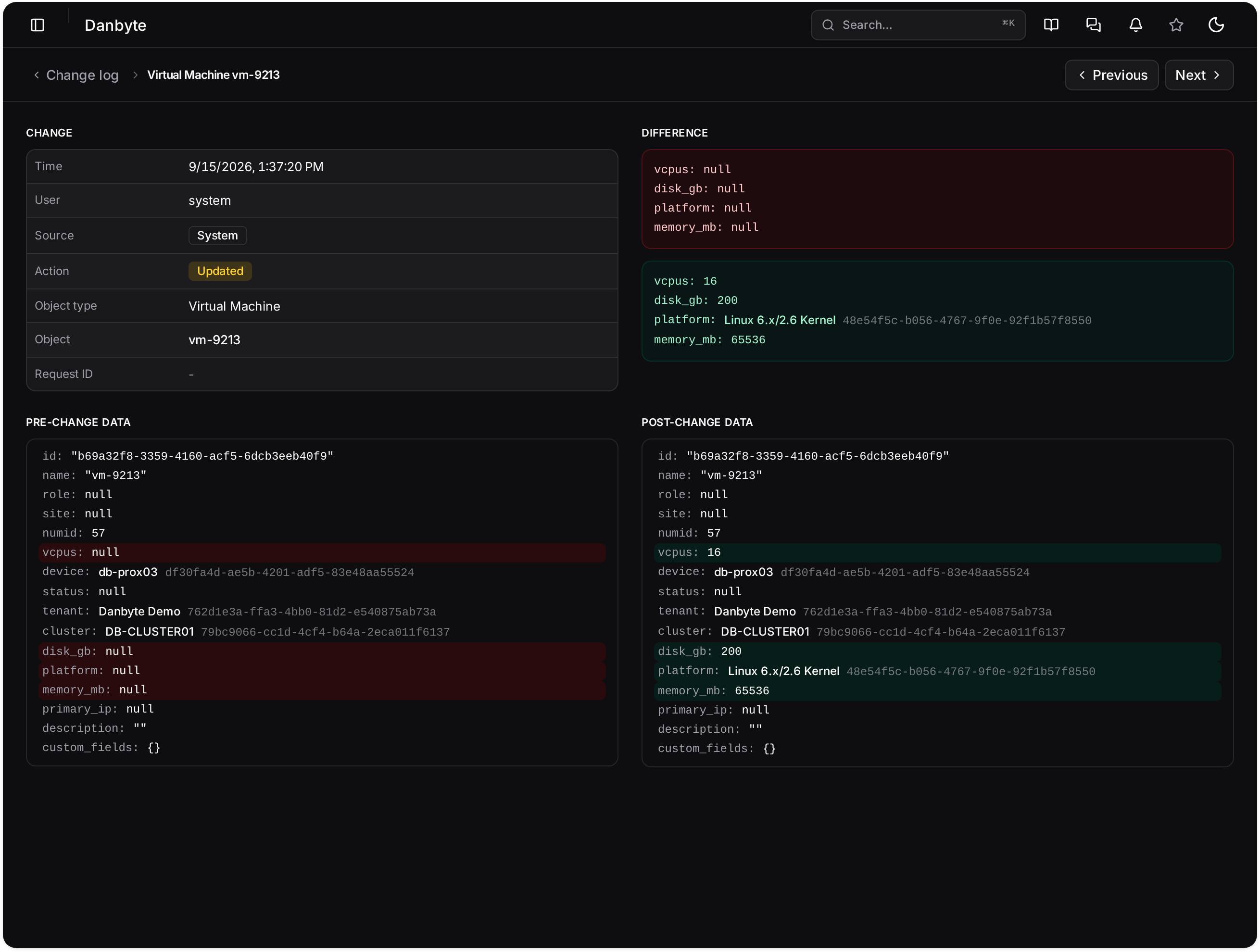
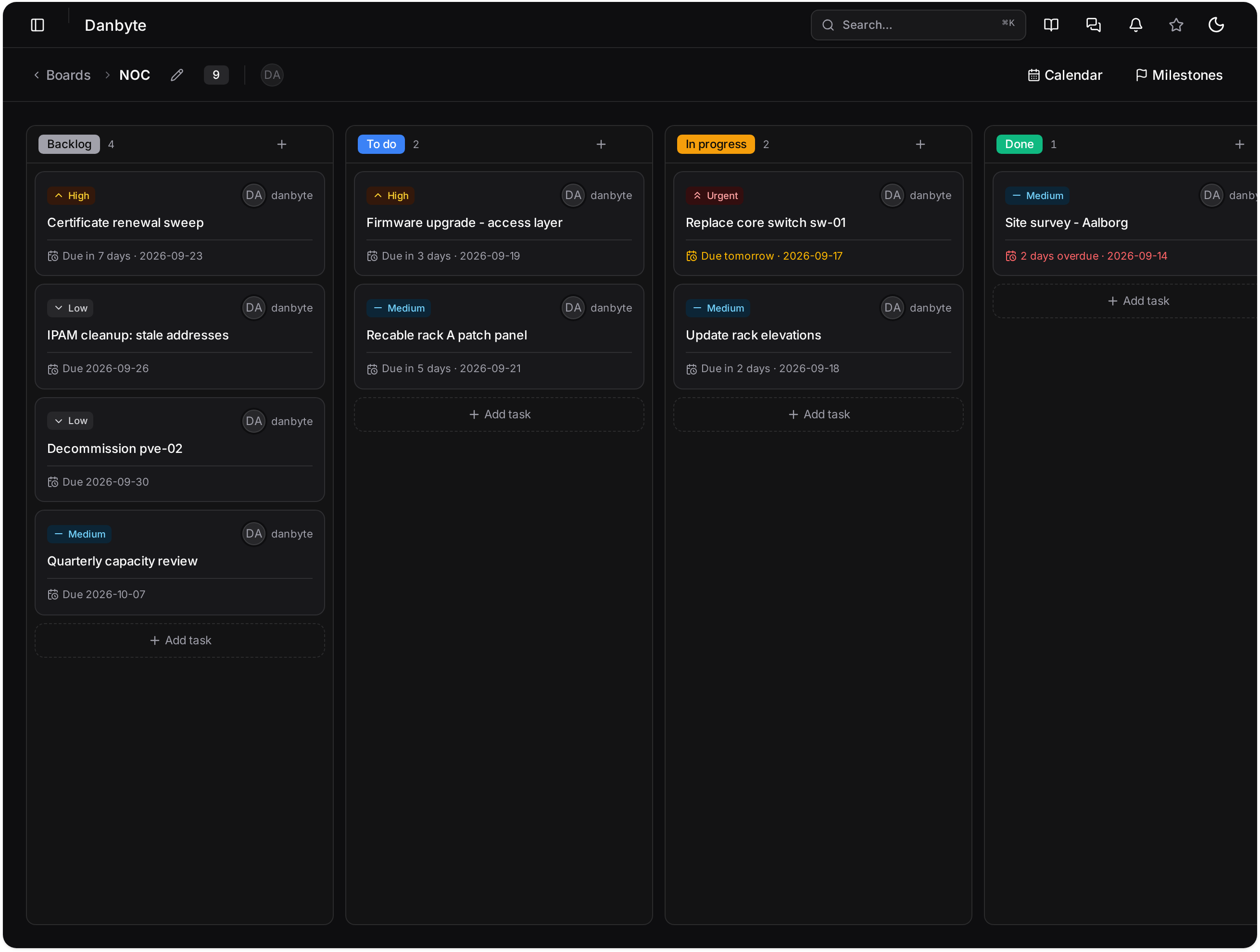
The change log is automatic and carries a diff. Journals are the human note beside it, and a planned change can be staged and applied rather than typed twice.
Site scoping that actually covers everything
A user can be limited to their own sites, and that limit now reaches every site-bound type: services, NAT rules, VLAN groups, IP ranges, virtual chassis, config snapshots, circuit, tunnel and L2VPN terminations, BGP address families and more.
An address belongs to its prefix's site when it has none of its own, and the change log and search will not name a related object the viewer is not allowed to see. A test fails if a new type is ever left out, so the gap cannot quietly reopen.
What happened, and who did it
Every change is logged automatically with a diff, including changes made over the API or by a sync. Journals are the human note beside an object, compliance rules turn policy into a list that is right every morning, and public share links let you show somebody a page without giving them an account.
Secrets that are not just fields
SNMPv3 keys, IPsec and FHRP authentication keys and integration credentials live in a secret store, with the built-in encrypted local store when nothing else is configured and HashiCorp Vault when it is. Revealing one is an audited action rather than a page view.
Questions
- Does SSO cost extra?
- No. SAML, OIDC, LDAP and MFA are in the open-source release like everything else. There is no enterprise tier and nothing is held back for the hosted version.
- Can one install serve several customers?
- Yes. Tenants keep their data apart, VRFs keep overlapping address space apart, and a person can be scoped to one tenant and to a subset of its sites.
- Can I see who changed something six months ago?
- Yes. The change log is automatic, carries a before and after per field, and records changes made through the API and by syncs as well as in the browser.
In the documentation
See it with real data.
The live demo is a private instance with a populated estate, yours for thirty minutes. Or install it yourself in a few minutes.