
The two questions an auditor asks, answered from the inventory.
Is this device under support, and is the software on it still supported? Danbyte tracks the contracts and warranty dates you enter, and maps platforms to endoflife.date, then reports both as a status on the device and a column in the list.
Contracts, and what a device inherits from them
A contract belongs to a manufacturer and carries its number, service level in your own words, start and end, reseller, cost and currency, a portal link, renewal notes and notification channels. Devices join by picking them or by pasting serial numbers.
A device's own Warranty end counts as coverage on its own, so gear that was never on a contract still reports honestly. The status is computed from the latest end among everything that covers it: Covered, Expiring, Expired or Not covered.
Cost is not for everyone
A contract's cost sits behind a *view cost* permission, in the API, in exports, in columns, on the form and in the change log. Operators can see what is covered without seeing what it costs.
Nothing here is guessed
Danbyte does not phone a vendor. You enter or import the contracts and the warranty dates, and the status follows from them, so what it reports is what you actually know.

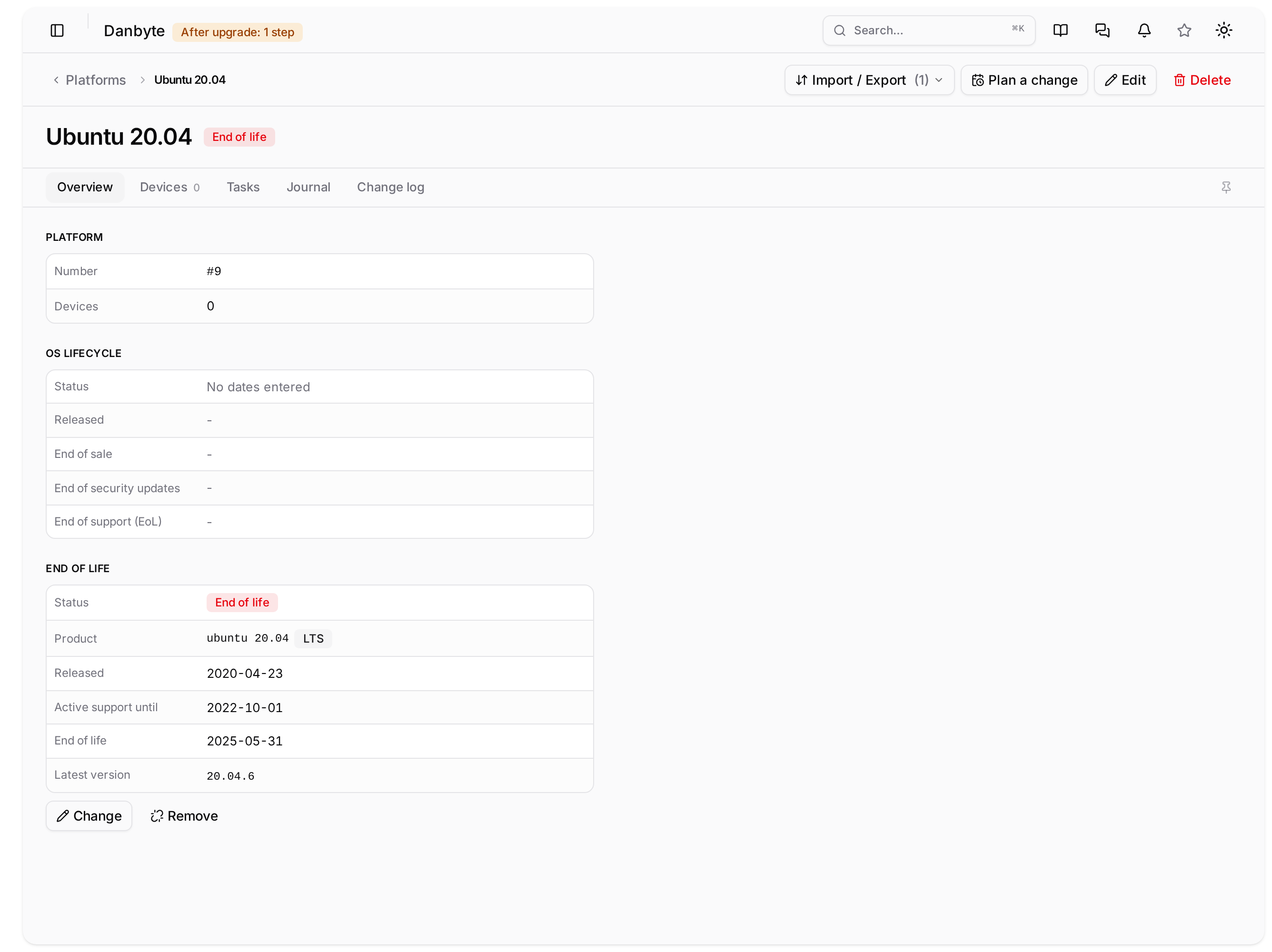
End-of-life data, mapped deliberately
Platforms can be mapped to a product and release cycle from endoflife.date. Nothing maps itself: suggestions are offered and never applied on their own, and the released, support-until, end-of-life, latest-version and LTS facts come from the catalog.
Status is *Supported*, *Support ending*, *End of life* or *Unknown*, and appears as a column and facet on the Platforms, Devices and Virtual machines lists.
Airgapped installs too
A connected install refreshes the catalog daily through the outbound guard, optionally from your own mirror. An airgapped one leaves the URL blank, takes the catalog file from a connected machine and imports it.
Both, as a compliance rule
Support coverage fails on expired or uncovered devices, and optionally on expiring ones. End-of-life status fails on end of life, on support ending or ended, or on having no data at all, across devices and virtual machines.
That turns two spreadsheet questions into a list that is right every morning.
Questions
- Does Danbyte fetch my contracts from the vendor?
- No. Contracts and warranty dates are entered or imported. Only the end-of-life catalog is fetched, from endoflife.date, and it describes software releases rather than your equipment.
- Does coverage apply to virtual machines?
- Support coverage is for devices. End-of-life status covers both devices and virtual machines, because it follows the platform rather than the hardware.
- Is end-of-life on by default?
- No. It is off and deployment-wide; a deployment admin switches it on and picks the source. The mappings themselves are per tenant.
In the documentation
See it with real data.
The live demo is a private instance with a populated estate, yours for thirty minutes. Or install it yourself in a few minutes.