
Enter the prefixes. Danbyte works out the rest.
The containment tree, the free space and the utilisation are computed from what you entered, per VRF. Nothing here is a number somebody keeps up to date by hand.
The tree is computed, not maintained
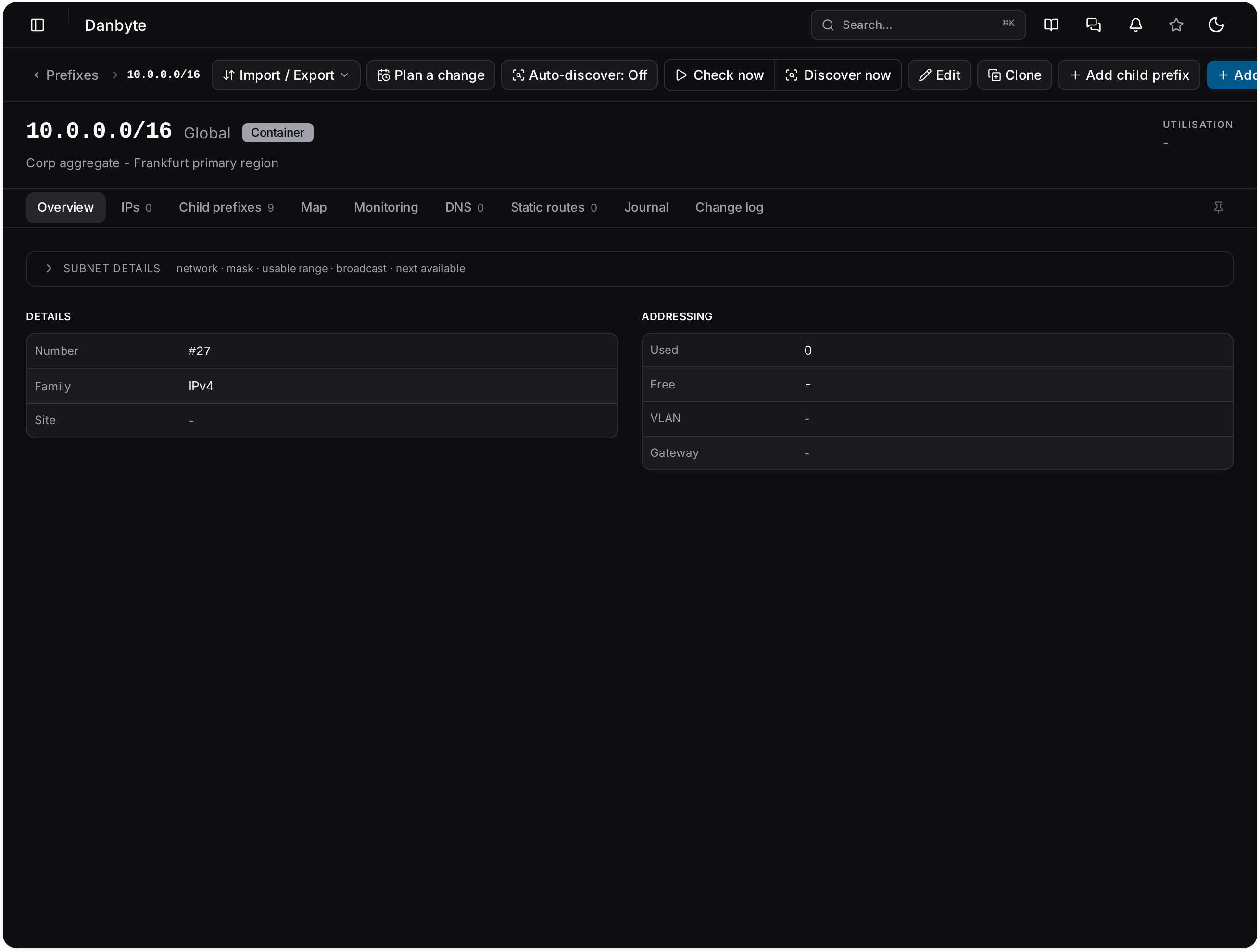
Prefixes nest by containment, so a /24 finds its /16 parent without being told. Utilisation and free space follow from the children, and both update the moment anything changes.
Everything is scoped by VRF, so overlapping address space in two VRFs is two separate trees rather than a conflict.
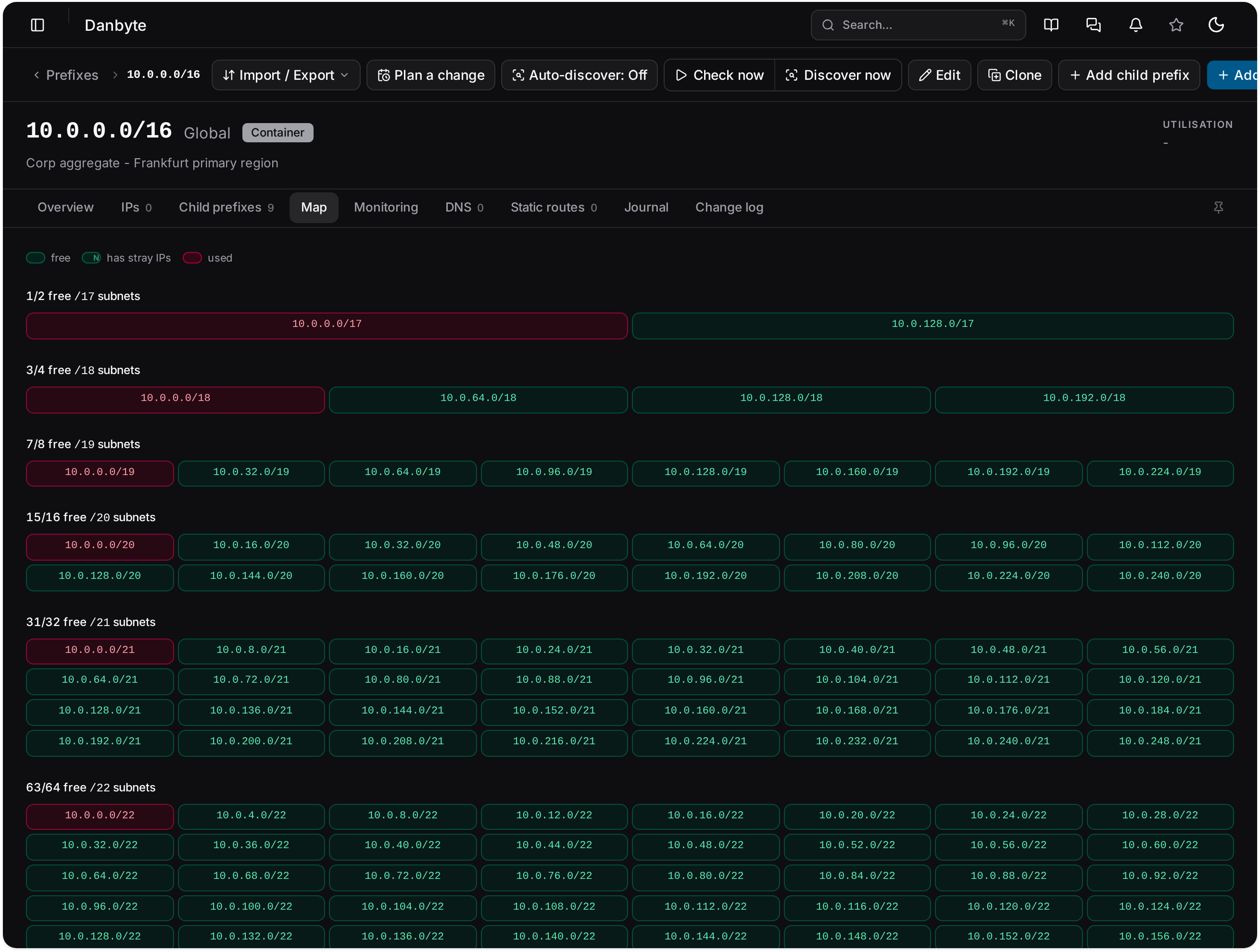
The space map
A block drawn as its children, to scale. A free block offers a new child prefix or a single address; ranges show as strips; rows past eight bits draw as strips rather than thousands of boxes.
Find the space, then take it
The space map draws a block's children to scale. Click a free one to carve a subnet, or register a single address, without working out the maths first.
What lives beside the prefixes
VLANs with groups and colours, VRFs with route targets, IP ranges, RIRs, aggregates and ASNs, FHRP groups, and service templates. Addresses carry a status and a role from catalogs you define rather than a fixed list.
- DHCP
- Scopes, exclusions and reservations, with live leases read from the server.
- DNS
- Forward and reverse zones, records, and a page per name with drift review.
- IP ranges
- A pool inside a prefix that cannot overlap another or sit outside its parent.
- Gateway autospawn
- The gateway address appears with the prefix instead of being typed again.
Utilisation that counts the same thing everywhere
Port utilisation uses one rule across the whole product: physical interfaces and front ports count, virtual ones only if you say so, rear ports never. The figure on a device, a rack, a floor plan, a spec sheet and an alert rule is the same figure.
Where a MAC actually is
Danbyte reads switch MAC tables over SNMP and maps each entry to its real port, telling uplinks apart from access ports. A MAC pasted into search, in any notation, answers with the switch and port it was learned on.
Questions
- Can I import from NetBox or a spreadsheet?
- Yes. There is a NetBox importer, and CSV, XLSX and JSON import for every object type, with a preview before anything is written.
- Does it handle IPv6 properly?
- Yes. Utilisation, next-available and search agree with each other on v6 as they do on v4, and aggregates are stored canonically so a network is counted once.
In the documentation
See it with real data.
The live demo is a private instance with a populated estate, yours for thirty minutes. Or install it yourself in a few minutes.